
A
Deep work
Single-task, focused effort on work that requires sustained thinking, such as writing, analysis, or design.
A closer look
This page describes the self-observation method taught in Session 1 and used throughout the thirty-day challenge. It is a logging practice, not a diagnostic tool, and it does not require any special software.
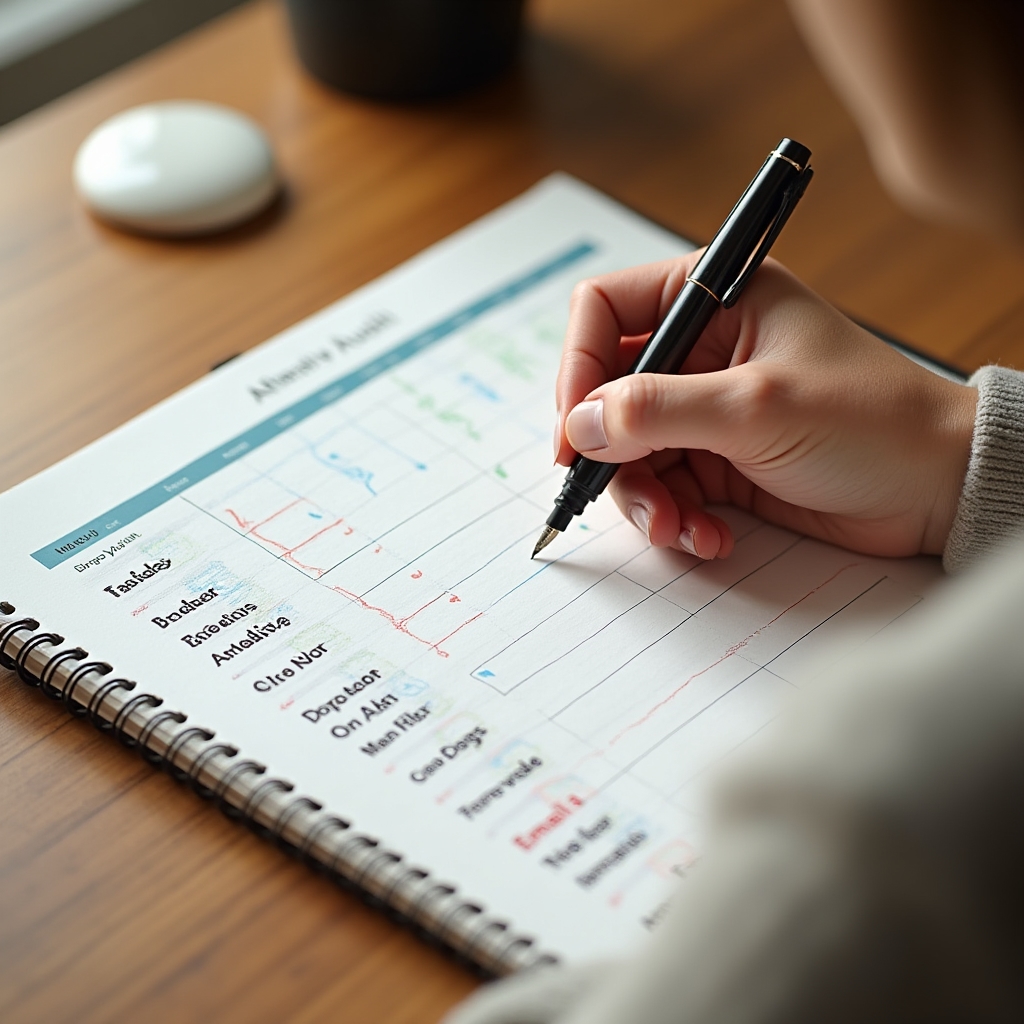
Why log at all
A guess about where the week went tends to be shaped by what felt significant, not by what actually took the most time. A short daily log corrects for that gap. It does not need to be precise to the minute. It needs to be consistent enough across a week to reveal a pattern.
Participants keep this log for the full thirty days of the challenge, reviewing it briefly at the end of each week during the live sessions and independently afterward.
The categories
The categories are intentionally broad. The goal is a usable weekly picture, not an exhaustive time-and-motion study.
Single-task, focused effort on work that requires sustained thinking, such as writing, analysis, or design.
Any scheduled call or in-person meeting, logged regardless of whether it felt necessary at the time.
Time spent in email, Slack, or similar tools, including both batched review windows and unplanned checking.
Time spent re-orienting after an interruption or switching between unrelated tasks, logged as its own line rather than folded into other categories.
How to log it
The method taught in the workshop uses three short check-in points rather than continuous tracking, which tends to become its own distraction.
A note on scope
The audit is meant to inform your own decisions about scheduling and communication habits. It is not a measurement tool for evaluating performance, and it produces no numeric score. The workshop presents it as a way of seeing your week more clearly, so any changes you make afterward are based on what actually happened rather than on impression alone.
See how this fits into Session 1